
Travel guide · Uzbekistan · Qish means winter
What to Wear in Uzbekistan in Winter
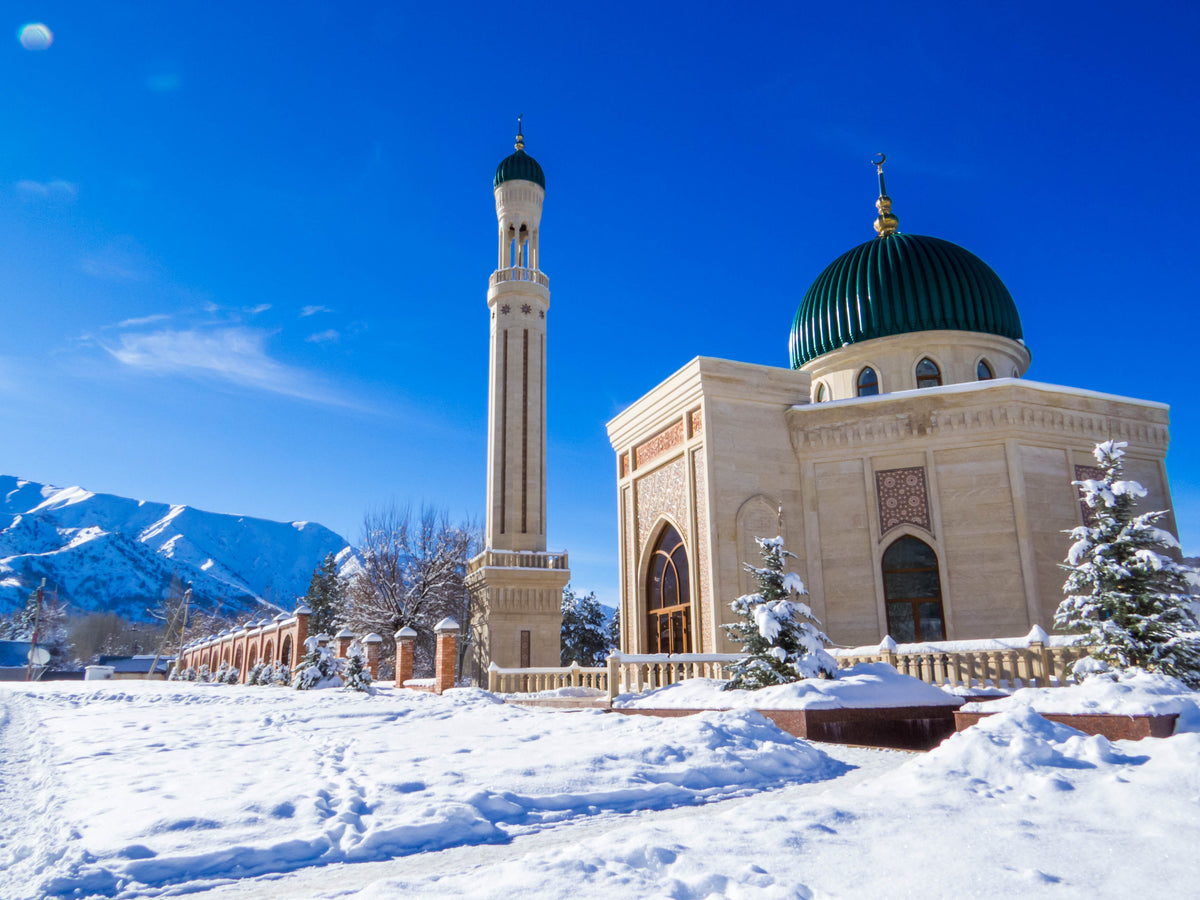
Uzbekistan in winter is blue domes under frost, quiet madrasas and warm tea houses. Days in Tashkent and Samarkand are often mild and sunny, but nights fall below freezing, and a Siberian cold wave can bring −18°C to the capital.
The short answer
Sunny at noon, frozen at night: pack for both.
A winter day in Uzbekistan often starts with frost on the tiles, warms to a bright, sunny afternoon among the madrasas, and ends with a cold night under clear skies. Merino against the skin keeps you warm in the early morning and comfortable when the sun comes out.
Month by month, Tashkent (400 m)
When to go, and what to pack
Average temperatures and daily hours of sunshine in the capital. Samarkand is very similar; Khiva and the north are much colder, and the mountains colder still.
January, place by place
From 11°C in Termez to below freezing all day in the mountains
Average temperatures in January, the coldest month, and which Sleet weight to pack.
Tashkent’s coldest recorded night is −29°C, and cold waves have brought −18°C as recently as 2014. Mountain figures are estimates: air cools by roughly 6°C for every 1,000 m you climb.
Winter moments
Four Uzbek winter moments, and what to wear for them
The Registan at dawn
Three blue-tiled madrasas around one square, silent and frosty in the early morning.
Wear: 240 GSM under your coat.
A tea house in Bukhara
Green tea and warm bread after a cold walk through the old town.
Wear: 240 GSM, comfortable indoors.
Khiva’s walls in winter
The walled city of the north-west, much colder than the rest of the country.
Wear: 300 GSM, top and long john.
A ski day near Tashkent
Snowy slopes and wide mountain views, an hour from the capital.
Wear: 300 GSM for full ski days.
Uzbek homes, tea houses and hotels are warm, and you step in and out all day. Merino breathes, so you stay comfortable inside and warm again outside.
Which Sleet weight
Choose for the coldest place on your trip
240 GSM Midweight
Tashkent · Samarkand · Bukhara · city days
Warm for towns and villages, light enough for long lunches, shops and evenings out.
Shop 240 GSM To −30°C300 GSM Heavyweight
Khiva · Chimgan · Amirsoy ski days · cold waves
For Khiva, the mountains, ski days and Siberian cold waves.
Shop 300 GSM For every travellerTwin Layer & Kids
Sensitive skin · children
Twin Layer: soft cotton inside, merino outside, cut for men and for women. Kids: extra-fine merino sets.
See the collectionCities and a ski day on the same trip? Take 240 for the old towns and 300 for the mountains.
How to layer
Three layers, easy to take off
- Base layerMerino against the skin, top and long john. Warm on the lift, cool enough at lunch.
- Middle layerA fine wool or cashmere jumper, or a light ski fleece. Off at the table, on again outside.
- Outer layerSki jacket and trousers for the slopes; a tailored wool coat for the village.
Mosques and madrasas ask for modest dress. A merino base layer keeps you warm under long, loose clothes, without bulk.
Packing list
- Merino base layer: two tops, one long john
- Wool jumper or fleece
- Warm coat, long and modest for mosque visits
- Hat, scarf and gloves
- Wool socks, two or three pairs
- Comfortable boots for old-town streets
- A scarf to cover the head in mosques
Questions travellers ask
How cold is Samarkand in winter?
In January, about 7°C by day and −1°C at night, often sunny. A 240 GSM base layer is right for city days.
Is Khiva colder than Samarkand?
Yes. Khiva is in the north-west, and January nights average about −7°C. Choose 300 GSM there.
Can it get very cold?
Yes. Siberian cold waves can bring −18°C to Tashkent and below −20°C elsewhere. If your trip is in January or February, take a 300 GSM as well.
Do you deliver to Uzbekistan?
Yes. Sleet delivers to Uzbekistan in 5–8 working days, so you can order before your trip or from home.
What size should I take?
See the size guide, or message us on WhatsApp and we will help you choose.
Knitted in Australia since 1982
Going to Uzbekistan this winter?
Tell us which cities you will visit. We will tell you which weight and size to take.
Delivered in 1–2 days in the UAE and 3–5 days across the GCC.